
What Is Power-to-Weight Ratio? A Complete Guide
Understand power-to-weight ratio — what it means, why it matters for cars, cycling, and engineering, and how to calculate P/W in W/kg, kW/kg, or hp/lb.
Featured image: What Is Power-to-Weight Ratio? A Complete Guide
What Is Power-to-Weight Ratio?
Power-to-weight ratio (P/W) is a measure of how much power an object or vehicle produces relative to its own mass. It answers the question: how much power is available for every kilogram (or pound) that needs to be moved?
The formula is simple:
P/W = Power ÷ Mass
A car producing 200 kW and weighing 1,000 kg has a P/W of 0.2 kW/kg. A cyclist outputting 300 W at 75 kg has a P/W of 4.0 W/kg. The units differ, but the concept is identical.
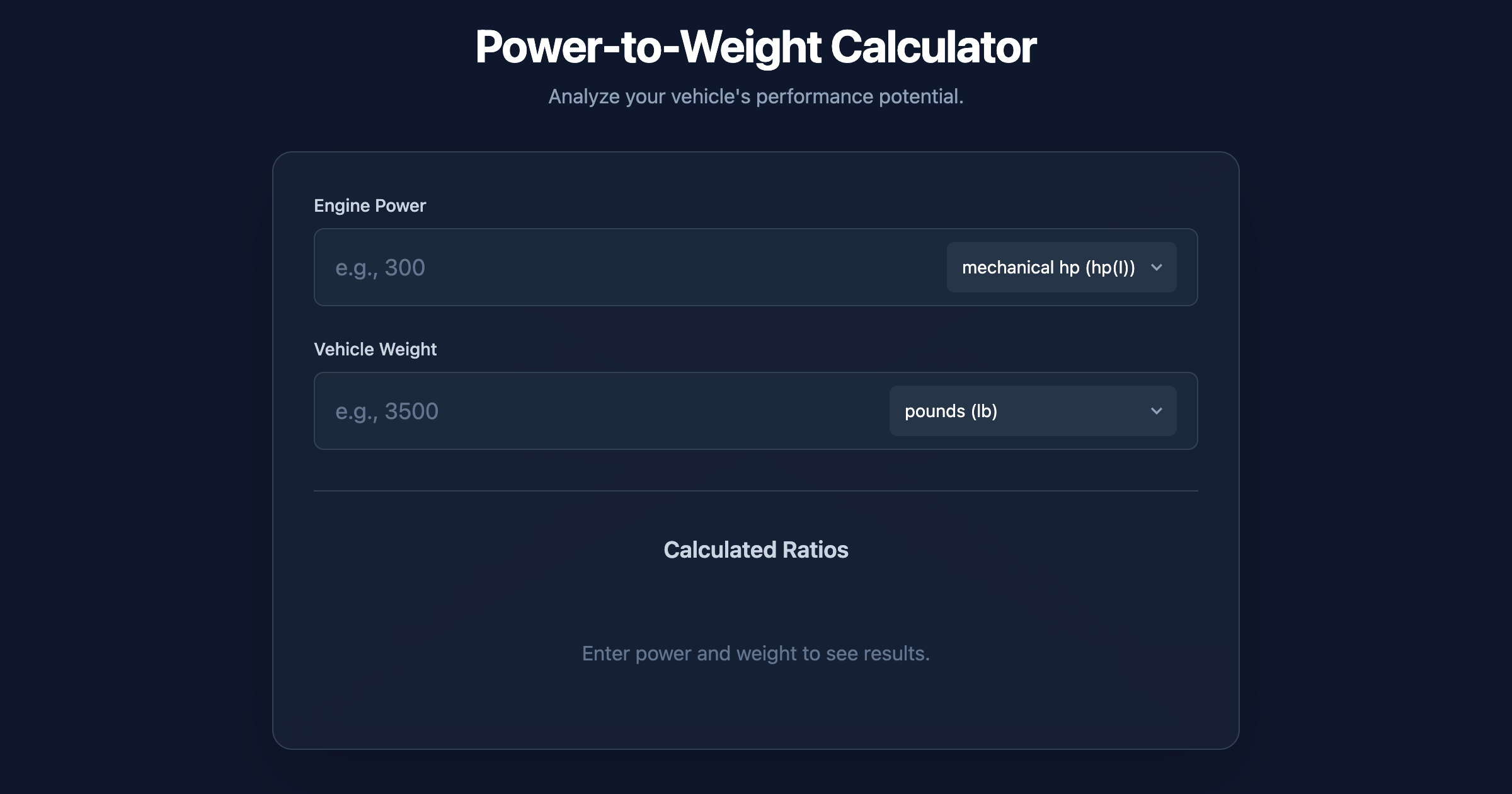
You can calculate your power-to-weight ratio instantly, choosing from over 20 power and mass unit combinations.
Why Power-to-Weight Ratio Matters
Raw power tells you nothing about real-world performance without knowing the mass it has to move. Two vehicles can both produce 200 kW — but if one weighs 1,000 kg and the other weighs 2,000 kg, their performance will be completely different.
P/W is the single most useful performance metric because it:
- Predicts acceleration — all else equal, the vehicle with the higher P/W accelerates faster.
- Levels the playing field — you can compare a lightweight sports car to a heavy saloon on equal terms.
- Works across domains — cars, motorcycles, aircraft, boats, cycling, and weightlifting all use variations of the same ratio.
- Guides engineering decisions — designers use it to balance performance targets against weight budgets.
The Power-to-Weight Ratio Formula
The general formula is:
P/W = Power / MassThe result depends on the units you use:
| Power unit | Mass unit | Result unit |
|---|---|---|
| Watts (W) | Kilograms (kg) | W/kg |
| Kilowatts (kW) | Kilograms (kg) | kW/kg |
| Mechanical horsepower (hp) | Pounds (lb) | hp/lb |
| Kilowatts (kW) | Tonnes (1,000 kg) | kW/tonne |
You must convert both values to the same base units before dividing. The P/W converter on this site handles all conversions automatically.
Common Units Explained
W/kg (Watts per kilogram)
The standard unit in cycling and scientific contexts. A trained amateur cyclist might sustain 3.0–4.0 W/kg at FTP. Tour de France contenders exceed 6.0 W/kg on climbs.
kW/kg (Kilowatts per kilogram)
The standard in automotive and motorcycle engineering. Most production cars fall in the range 0.05–0.35 kW/kg.
hp/lb (Horsepower per pound)
Commonly used in US automotive and motorsport contexts. A sports car with 0.1 hp/lb is considered quick; supercars exceed 0.3 hp/lb.
kW/tonne (Kilowatts per tonne)
Often used for motorcycles (e.g., the Australian LAMS limit of 150 kW/tonne) and large vehicles.
Conversion: 1 kW/kg = 1,000 W/kg = 0.6083 hp/lb
Power-to-Weight Ratio Across Different Domains
Cars
Car P/W ranges from around 0.04 kW/kg (city car) to over 0.60 kW/kg (hypercar). Most family cars sit at 0.06–0.09 kW/kg. A useful rule of thumb: cars with 0.10+ kW/kg feel genuinely quick.
- City car (e.g. Toyota Aygo): ~0.05 kW/kg
- Family saloon (e.g. Toyota Camry): ~0.08 kW/kg
- Hot hatch (e.g. VW Golf GTI): ~0.13 kW/kg
- Sports car (e.g. Porsche 911): ~0.19 kW/kg
- Supercar (e.g. Lamborghini Huracán): ~0.32 kW/kg
- Formula 1 car: >1.0 kW/kg
Try the car power-to-weight ratio calculator for specific models.
Motorcycles
Motorcycles achieve dramatically higher P/W than cars because of their low mass. A 600cc sportbike at 0.49 kW/kg easily matches most supercars.
- LAMS learner bike (AU): ≤ 0.15 kW/kg
- Middleweight naked: 0.25–0.45 kW/kg
- 600cc sportbike: 0.45–0.55 kW/kg
- Litre-class superbike: 0.65–0.80 kW/kg
Use the motorcycle P/W calculator or the LAMS calculator for Australian learner compliance.
Cycling
In cycling, W/kg is the most important fitness metric. It determines how fast you can climb, sustained over long efforts.
- Untrained: < 2.0 W/kg
- Recreational rider: 2.0–2.9 W/kg
- Trained club rider: 3.0–3.5 W/kg
- Competitive amateur: 3.6–4.3 W/kg
- Elite amateur / Cat 1: 4.4–5.1 W/kg
- Professional: 5.5–7.0+ W/kg
See the cycling W/kg calculator for your category.
Aircraft
For piston and turboprop aircraft, shaft P/W in kW/kg or hp/lb is meaningful. Jet aircraft use thrust-to-weight ratio (dimensionless) instead, since jet engines produce thrust, not shaft power.
- Light GA aircraft (e.g. Cessna 172): ~0.12 kW/kg
- Aerobatic aircraft: 0.25–0.40 kW/kg
Learn more on the aircraft P/W page.
Boats
Marine P/W determines whether a planing hull can get up on plane. A minimum of around 0.018–0.025 kW/kg is needed for planing. Performance powerboats exceed 0.10 kW/kg.
See the boat P/W calculator.
Is a Higher Power-to-Weight Ratio Always Better?
For pure acceleration and climbing performance, yes — a higher P/W ratio means better performance, everything else being equal. But real-world performance also depends on:
- Aerodynamics — drag increases with the square of speed, so at high speeds aero matters more than P/W.
- Traction — excess power relative to tyre grip causes wheelspin, which hurts acceleration.
- Weight distribution and handling — a well-balanced, lighter car may outhandle a heavier car with higher P/W.
- Fuel economy — higher P/W engines often consume more fuel under similar conditions.
P/W is the starting point for performance analysis, not the complete picture.
Frequently Asked Questions
Can I compare a car and a motorcycle using P/W? Yes — that’s one of the strengths of P/W as a metric. A litre-class superbike at 0.70 kW/kg has roughly the same P/W as a Formula 1 car circa the 1990s. Despite very different technologies, the ratio makes the comparison meaningful.
What is the highest power-to-weight ratio ever recorded? Among road vehicles, top-fuel dragsters exceed 25 kW/kg. Fighter jets have thrust-to-weight ratios above 1.0 (meaning they can accelerate vertically). Among production road cars, the Koenigsegg Jesko Absolut at around 0.78 kW/kg is near the top.
Does P/W change when I add passengers or cargo? Yes — adding mass reduces P/W. This is why performance figures are usually measured at kerb weight (no passengers) and why cyclists track their own body weight carefully alongside training power.
Summary
Power-to-weight ratio is a simple but powerful metric: divide power by mass. The unit you use depends on your context — W/kg for cycling, kW/kg for cars and motorcycles, hp/lb for US automotive. Use our free calculator to convert between any combination of power and mass units instantly.
For the step-by-step formula and worked examples, see How to Calculate Power-to-Weight Ratio.