
Power-to-Weight Ratio Chart: Best Cars Ranked (2025)
Comprehensive power-to-weight ratio chart for 40+ production cars ranked from city cars to hypercars. Find the best kW/kg and hp/lb figures for 2024/2025 models.
Featured image: Power-to-Weight Ratio Chart: Best Cars Ranked (2025)
How We Calculated These Figures
All P/W ratios in this chart use manufacturer-stated peak power (at the crank) divided by kerb weight (vehicle ready to drive, no passengers or cargo, full fluids). Figures are based on base-model specs unless noted.
Power has been converted to kW where manufacturer figures were in hp. Use the car P/W calculator to check any car not listed here.
City Cars & Superminis (0.04–0.08 kW/kg)
| Make & Model | Power (kW) | Kerb Weight (kg) | P/W (kW/kg) |
|---|---|---|---|
| Toyota Aygo X 1.0 | 53 | 975 | 0.054 |
| Volkswagen Polo 1.0 TSI 95 | 70 | 1,175 | 0.060 |
| Renault Clio 1.0 TCe 90 | 66 | 1,145 | 0.058 |
| Ford Fiesta 1.0 EcoBoost 95 | 70 | 1,117 | 0.063 |
| Hyundai i20 1.0 T-GDi 100 | 74 | 1,185 | 0.062 |
| MINI Cooper 3-door 1.5 | 100 | 1,220 | 0.082 |
Family Cars & Saloons (0.06–0.12 kW/kg)
| Make & Model | Power (kW) | Kerb Weight (kg) | P/W (kW/kg) |
|---|---|---|---|
| Toyota Camry 2.5 Hybrid | 131 | 1,575 | 0.083 |
| Volkswagen Passat 2.0 TDI 150 | 110 | 1,470 | 0.075 |
| Honda Accord 1.5T | 143 | 1,509 | 0.095 |
| BMW 3 Series 320i | 135 | 1,575 | 0.086 |
| Mercedes C-Class C200 | 150 | 1,630 | 0.092 |
| Mazda 6 2.5 | 139 | 1,528 | 0.091 |
| Skoda Octavia 1.5 TSI 150 | 110 | 1,335 | 0.082 |
Hot Hatches (0.10–0.18 kW/kg)
| Make & Model | Power (kW) | Kerb Weight (kg) | P/W (kW/kg) |
|---|---|---|---|
| Volkswagen Golf GTI | 180 | 1,412 | 0.127 |
| Honda Civic Type R | 228 | 1,414 | 0.161 |
| Hyundai i30 N | 202 | 1,429 | 0.141 |
| Ford Focus ST 2.3 | 206 | 1,478 | 0.139 |
| MINI JCW | 170 | 1,305 | 0.130 |
| Renault Megane R.S. 300 | 221 | 1,410 | 0.157 |
Sports Cars (0.15–0.30 kW/kg)
| Make & Model | Power (kW) | Kerb Weight (kg) | P/W (kW/kg) |
|---|---|---|---|
| Porsche 911 Carrera | 283 | 1,515 | 0.187 |
| BMW M2 G87 | 338 | 1,725 | 0.196 |
| Chevrolet Corvette C8 Stingray | 369 | 1,527 | 0.242 |
| Alpine A110 | 207 | 1,103 | 0.188 |
| Lotus Emira V6 | 298 | 1,405 | 0.212 |
| Mazda MX-5 Miata 2.0 | 135 | 1,049 | 0.129 |
| Toyota GR86 | 172 | 1,278 | 0.135 |
| Porsche 718 Cayman GTS 4.0 | 294 | 1,385 | 0.212 |
| Ford Mustang Shelby GT500 | 527 | 1,930 | 0.273 |
Supercars (0.25–0.55 kW/kg)
| Make & Model | Power (kW) | Kerb Weight (kg) | P/W (kW/kg) |
|---|---|---|---|
| Lamborghini Huracán EVO | 449 | 1,422 | 0.316 |
| Ferrari 296 GTB | 546 | 1,470 | 0.371 |
| McLaren 720S | 527 | 1,283 | 0.411 |
| Porsche 911 GT3 RS | 386 | 1,450 | 0.266 |
| Aston Martin Vantage F1 Edition | 375 | 1,570 | 0.239 |
| Alfa Romeo 4C | 177 | 895 | 0.198 |
| Mercedes-AMG GT Black Series | 537 | 1,630 | 0.329 |
| BMW M5 CS | 467 | 1,825 | 0.256 |
Hypercars (0.50–0.90+ kW/kg)
| Make & Model | Power (kW) | Kerb Weight (kg) | P/W (kW/kg) |
|---|---|---|---|
| Bugatti Chiron Super Sport 300+ | 1,176 | 1,978 | 0.595 |
| Koenigsegg Jesko | 1,103 | 1,420 | 0.777 |
| McLaren P1 | 674 | 1,395 | 0.483 |
| Ferrari LaFerrari | 708 | 1,255 | 0.564 |
| Porsche 918 Spyder | 652 | 1,674 | 0.390 |
| Rimac Nevera (EV) | 1,100 | 2,150 | 0.512 |
| Aston Martin Valkyrie | 857 | 1,000 | 0.857 |
Electric Cars (for comparison)
| Make & Model | Power (kW) | Kerb Weight (kg) | P/W (kW/kg) |
|---|---|---|---|
| Tesla Model 3 Long Range AWD | 351 | 1,844 | 0.190 |
| Tesla Model S Plaid | 750 | 2,162 | 0.347 |
| Porsche Taycan Turbo S | 560 | 2,295 | 0.244 |
| BMW iX M60 | 442 | 2,510 | 0.176 |
| Hyundai Ioniq 6 AWD | 239 | 2,030 | 0.118 |
Race Cars (context)
| Vehicle | Power (kW) | Weight (kg) | P/W (kW/kg) |
|---|---|---|---|
| Formula 1 (2023) | ~960 | 798 (min) | ~1.20 |
| MotoGP motorcycle | ~260 | 157 (min) | ~1.66 |
| Le Mans Hypercar | ~500 | 1,030 (min) | ~0.49 |
| NASCAR Cup Series | ~522 | ~1,542 | ~0.34 |
Key Takeaways
-
Kerb weight matters as much as power. A light sports car at 0.20 kW/kg will feel faster than a heavier car at 0.22 kW/kg if the lighter car has better aero, balance, and traction.
-
EVs are heavy. Battery packs add significant mass — even a Tesla Model S Plaid at 0.35 kW/kg carries nearly 1,000 kg more than a comparable petrol hypercar.
-
The lightweights punch above their weight. The Aston Martin Valkyrie (0.86 kW/kg) and Koenigsegg Jesko (0.78 kW/kg) achieve supercar P/W numbers that a similarly-powered heavier car can’t match.
-
Hot hatches are surprisingly close to sports cars. The Honda Civic Type R at 0.16 kW/kg is not far behind many sports cars — and it has four seats and a boot.
Calculate Your Own Car’s P/W
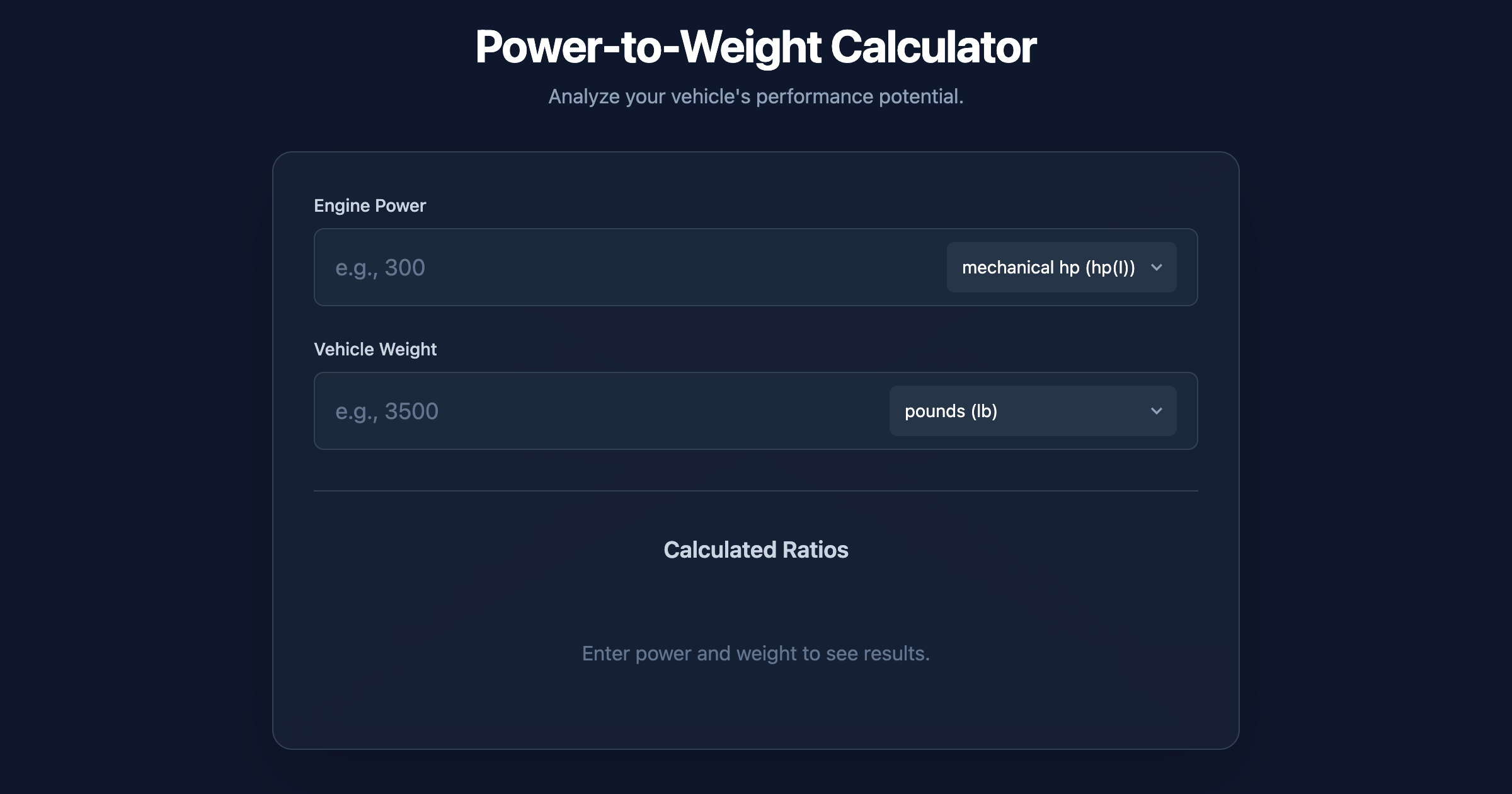
Use the car power-to-weight ratio calculator to enter your exact power and weight figures. The calculator supports kW, hp, and metric horsepowers for power, and kilograms, pounds, and tonnes for weight — with instant results in kW/kg or hp/lb.
For context on what these numbers mean, read What Is Power-to-Weight Ratio?