
How to Calculate Power-to-Weight Ratio: Formula & Examples
Step-by-step guide to calculating power-to-weight ratio. Includes the formula, worked examples for cars (kW/kg), cycling (W/kg), and hp/lb, plus a unit conversion cheat sheet.
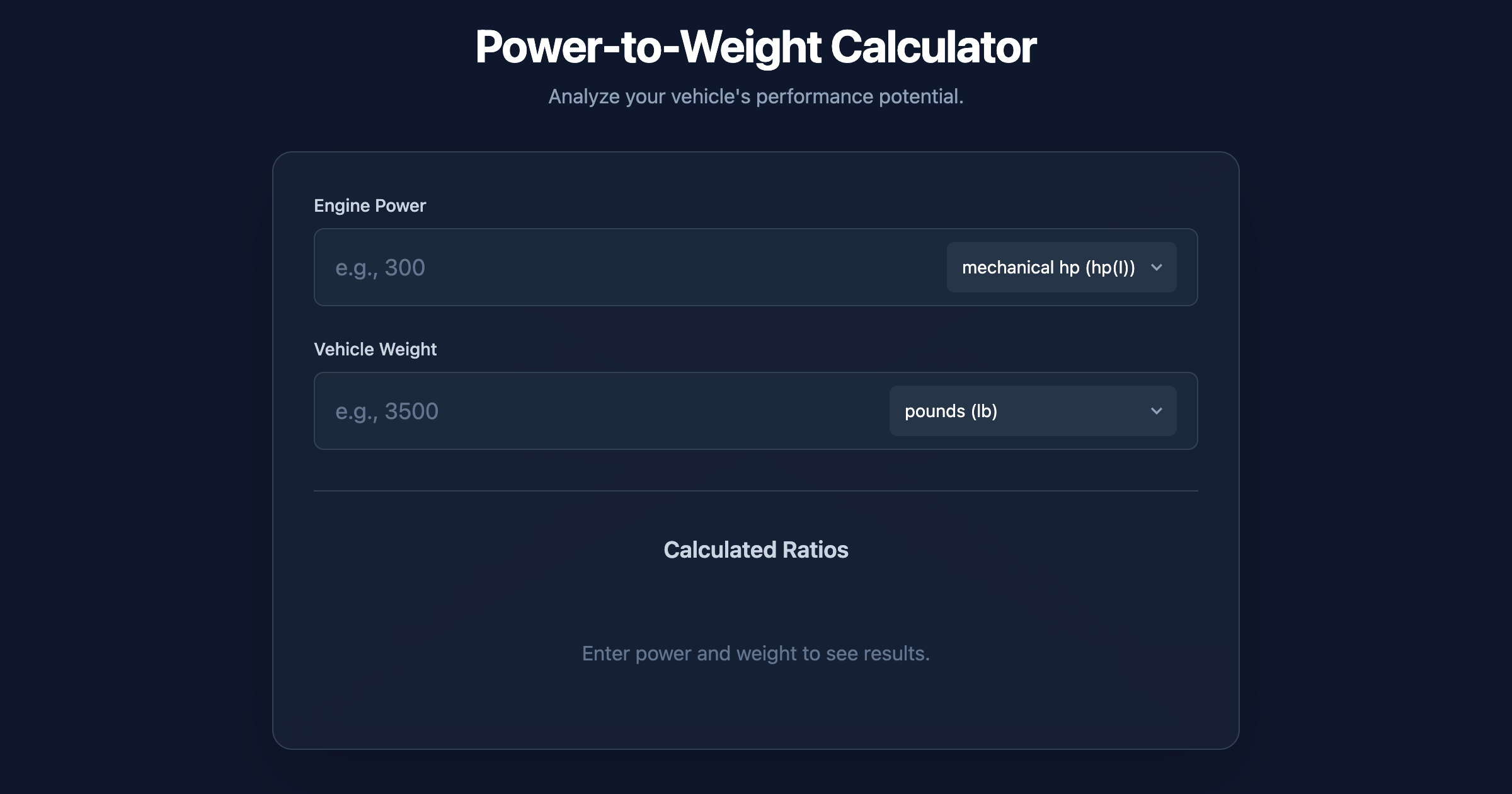
Featured image: How to Calculate Power-to-Weight Ratio: Formula & Examples
The Power-to-Weight Ratio Formula
The formula is straightforward:
P/W = Power ÷ Mass
The tricky part is making sure your power and mass values are in compatible units before dividing. The table below shows the most common combinations:
| If your power is in… | And your mass is in… | Then your P/W will be in… |
|---|---|---|
| Watts (W) | Kilograms (kg) | W/kg |
| Kilowatts (kW) | Kilograms (kg) | kW/kg |
| Kilowatts (kW) | Tonnes (t) | kW/tonne |
| Horsepower (hp) | Pounds (lb) | hp/lb |
If your units don’t match one of these pairs, convert first — or use the P/W calculator which handles all conversions automatically.
Step-by-Step: How to Calculate P/W
Step 1 — Find your power figure
Look up the engine’s rated output. For cars and bikes, this is usually listed as kW or hp in the manufacturer spec sheet. For cyclists, use your FTP (Functional Threshold Power) in watts.
Step 2 — Find your mass figure
- Cars: Use kerb weight (vehicle weight without passengers or cargo, but with all fluids).
- Motorcycles: Use wet weight (ready to ride with all fluids).
- Cyclists: Use your body weight in kilograms (not body + bike).
- Aircraft: Use MTOW (Maximum Takeoff Weight) for standard comparisons.
Step 3 — Convert to matching units
Make sure power and mass are in compatible units. See the conversion cheat sheet below.
Step 4 — Divide
P/W = Power ÷ Mass
Worked Example 1: Car in kW/kg
Scenario: A Porsche 911 Carrera produces 283 kW and has a kerb weight of 1,515 kg.
P/W = 283 kW ÷ 1,515 kg
P/W = 0.187 kW/kg
That’s 187 W/kg, which puts it firmly in sports car territory.
To convert to hp/lb:
- 283 kW ÷ 0.7457 = 379.5 hp
- 1,515 kg × 2.2046 = 3,340 lb
- 379.5 hp ÷ 3,340 lb = 0.114 hp/lb
Worked Example 2: Cyclist in W/kg
Scenario: A club cyclist has an FTP of 280 W and weighs 72 kg.
P/W = 280 W ÷ 72 kg
P/W = 3.89 W/kg
According to the Coggan power profile, this places them in the Cat 3 / Trained category. They’re competitive at local club level and should be solid on shorter climbs.
Use the cycling W/kg calculator to see which category your own figures fall into.
Worked Example 3: Imperial (hp/lb)
Scenario: A muscle car produces 450 hp and weighs 3,600 lb.
P/W = 450 hp ÷ 3,600 lb
P/W = 0.125 hp/lb
This is a strong figure for a street car. As a rough comparison:
- 0.050 hp/lb = typical family car
- 0.100 hp/lb = sports car territory
- 0.200 hp/lb = supercar territory
- 0.300+ hp/lb = hypercar / race car
Worked Example 4: Motorcycle in kW/kg
Scenario: A Kawasaki Ninja ZX-10R produces 147 kW and has a wet weight of 207 kg.
P/W = 147 kW ÷ 207 kg
P/W = 0.710 kW/kg
For context, the Australian LAMS limit for learner bikes is 0.150 kW/kg — this superbike is more than four times the limit. Use the LAMS calculator to check learner compliance.
Unit Conversion Cheat Sheet
Power conversions (to watts)
| From | Multiply by | To get |
|---|---|---|
| kW | × 1,000 | W |
| hp (mechanical) | × 745.7 | W |
| hp (metric) | × 735.5 | W |
| MW | × 1,000,000 | W |
Mass conversions (to kilograms)
| From | Multiply by | To get |
|---|---|---|
| Pounds (lb) | × 0.4536 | kg |
| Tonnes (t) | × 1,000 | kg |
| Grams (g) | × 0.001 | kg |
| US short tons | × 907.2 | kg |
P/W ratio conversions
| From | Multiply by | To get |
|---|---|---|
| kW/kg | × 1,000 | W/kg |
| kW/kg | × 0.6083 | hp/lb |
| hp/lb | × 1.6438 | kW/kg |
| kW/tonne | ÷ 1,000 | kW/kg |
| kW/tonne | ÷ 1,000 × 1,000 | W/kg |
Common Mistakes to Avoid
1. Mixing units
This is the most frequent error. If power is in kW and you divide by mass in grams, you’ll get an astronomically small number. Always convert to a consistent base before dividing — or let the calculator handle it.
2. Using the wrong weight figure
- Cars: Using GVW (gross vehicle weight) instead of kerb weight gives a much lower P/W that doesn’t reflect performance.
- Motorcycles: Using dry weight instead of wet weight overstates performance.
- Cyclists: Using combined rider + bike weight is non-standard; the Coggan benchmarks all use body weight only.
3. Using peak vs. sustained power for cycling
For cyclist W/kg, use FTP (Functional Threshold Power) — not your 5-second sprint peak. FTP represents the power you can hold for roughly an hour and is the standard for all competitive benchmarks.
4. Confusing kW/kg with kW/tonne
These are 1,000× different. A car at 0.15 kW/kg is also 150 kW/tonne. Make sure you know which unit is being quoted — the LAMS limit, for example, is stated as 150 kW/tonne, which is 0.15 kW/kg.
Quick Reference: P/W Benchmarks
| Vehicle / Athlete | P/W |
|---|---|
| City car | 0.04–0.06 kW/kg |
| Family car | 0.06–0.10 kW/kg |
| Sports car | 0.15–0.25 kW/kg |
| Supercar | 0.30–0.55 kW/kg |
| F1 car | > 1.0 kW/kg |
| LAMS motorcycle (AU limit) | ≤ 0.15 kW/kg |
| Litre-class superbike | 0.65–0.80 kW/kg |
| Untrained cyclist | < 2.0 W/kg |
| Trained club cyclist | 3.0–3.5 W/kg |
| Professional cyclist | 5.5–7.0+ W/kg |
| Light GA aircraft (e.g. Cessna 172) | ~0.12 kW/kg |
Use the Calculator
Rather than doing the arithmetic manually, use the free P/W converter — enter any power value in any unit (W, kW, hp, etc.) and any mass value in any unit (kg, lb, tonnes, etc.) and get the result instantly in W/kg, kW/kg, or hp/lb.
For a deeper explanation of what the ratio means and why it matters, read What Is Power-to-Weight Ratio?